
The best water-free dry cleaning solvents for upholstery must match your fabric’s care code and stain type.
A greasy mark on a sofa can turn a quick cleanup into a costly mistake. Add water to the wrong fabric, and you may leave a ring, spread the stain, or harm the finish. I look for a cleaner that suits the fabric first, then the stain. This guide compares four listed options, from a dry cleaning fluid to foam and fabric-care products. They do not all serve the same role. I explain those key differences so you can choose with care, rather than assume that “dry cleaning” or “no-rinse” means water-free.
See the differences between my top picks at a glance.
| Product | Listed format | Listed size | Water-free status | Main buying use | Amazon link |
|---|---|---|---|---|---|
| Imperial Cleaner and Spot Remover | Dry cleaning fluid | 32 fl oz, pack of 4 | Check current label and safety data sheet | Solvent-based spot cleaning, if approved for the fabric | View on Amazon |
| Upholstery Dry Cleaning Foam | No-rinse foam | Not stated in supplied title | Not established; no-rinse does not mean water-free | Foam cleaning where the care label permits it | View on Amazon |
| Bissell Spot & Stain, 9351 | Fabric and upholstery cleaner | 12 oz | Not established by the supplied product information | Small fabric stains, subject to label approval | View on Amazon |
| Sunbrella Extract + Restore Bundle | Oil stain remover and fabric protector | Extract: 9.6 oz; Restore: 32 fl oz | Do not treat the bundle as a verified water-free solvent | Compatible fabric oil-stain care and protection | View on Amazon |
I may earn a commission from purchases made through these links. This guide assesses the supplied product details, not hands-on tests. I cannot verify live Amazon reviews, current prices, or formula changes. The ratings below show editorial buying fit, not measured cleaning results or Amazon star scores.
Upholstery Dry Cleaning Foam: No-Rinse Fabric Cleaner

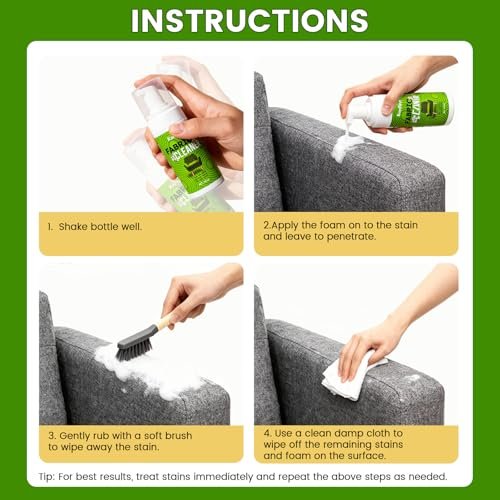
This no-rinse foam targets sofas, couches, and car seats, according to its supplied title. Its main appeal is a cleaning process that does not call for a separate rinse. That may suit a shopper who wants to treat a small mark without using a full extraction machine. Still, I would not place it among verified water-free solvents based on its name alone.
A foam can contain water even when the seller calls it a dry cleaner. I would check the full label, ingredients, and fabric limits before use, with extra care on an S-code sofa. The listing also claims suitability for homes with kids and pets, but that is not proof of harmless exposure. Keep both away during treatment and follow the label’s drying and re-entry rules.
Pros:
- The listed no-rinse format may reduce cleanup steps on approved fabrics.
- The product targets sofas and couches, rather than only hard household surfaces.
- Its listed car-seat use may appeal to buyers with more than one fabric-cleaning task.
- A foam format may help with controlled spot treatment when used as directed.
- It offers an option to assess if you want a cleaner that does not require a rinse stage.
- The stated focus on stains and dirt suits routine fabric care better than a protector-only product.
Cons:
- The supplied details do not prove that the formula is water-free.
- The listed title gives no package size, which limits cost-per-ounce comparisons.
- Claims about child and pet safety need support from the current label and use instructions.
What Amazon Buyers Are Saying
I do not have verified Amazon review text for this item, so I cannot report buyer praise or complaints as facts. Before buying, I would look for reviews that name the fabric, care code, and stain treated. Reports about rings after drying, leftover foam, scent, and repeat use would matter more to me than a brief claim that the sofa “looks great.” Check that any review refers to this exact product and current variant.
My Recommendation
I would consider this foam for a small cleaning job only when both the fabric maker and cleaner label allow it. I would not choose it for an S-only sofa until the formula and directions clearly support solvent-only care. That distinction matters when shopping for the Best Water-Free Dry Cleaning Solvents for Upholstery: a convenient foam is not necessarily a true dry cleaning solvent.
My overall editorial buying-fit rating is 2.5/5 for this specific search. That score reflects a useful listed format but a major gap in water-free confirmation. It does not rate cleaning strength, odor, or fabric safety, which I have not tested. If your couch allows this type of cleaner, its fit for your needs may be better than the narrow solvent-focused score suggests.
| Buying-fit category | Editorial rating |
|---|---|
| Relevance to routine fabric spot care | 4/5 |
| No-rinse format appeal | 4/5 |
| Water-free suitability evidence | 1/5 |
| Package detail clarity | 1/5 |
| Overall buying fit | 2.5/5 |
Imperial Cleaner and Spot Remover, 32 fl oz, 4-Pack

Imperial is the closest match to the requested category because the supplied title explicitly describes a dry cleaning fluid and solvent. It also lists upholstery, clothing, and automotive tar-removal uses. The pack includes four 32-fluid-ounce containers, for a listed total of 128 fluid ounces. I see it as the first product to investigate for approved solvent-based spot care, not as a cleaner to apply without checks.
The broad range of listed uses calls for care, since car surfaces and sofa fabrics have different limits. I would read the current safety data sheet, often called an SDS, to check composition, handling, and storage needs. I would also confirm that the directions allow the exact fabric and stain involved. A solvent may affect dye, glue, backing, or trim even when the surface seems sturdy.
Pros:
- The title directly identifies the product as a dry cleaning fluid and solvent.
- Upholstery appears among its listed uses, which makes it relevant to this guide.
- The clear 32-fluid-ounce size helps buyers assess the amount they will receive.
- The four-pack may suit repeated approved spot-cleaning tasks.
- Its listed clothing use may add value for buyers with compatible fabric-care needs.
- The separate tar-removal claim gives buyers a clear reason to investigate its directions for tough oily marks.
Cons:
- The supplied title does not replace a current ingredient list or SDS.
- A four-pack may be too much for one small stain or a home with limited safe storage.
- Its listed multi-surface uses do not prove safety on every upholstery fabric, finish, or backing.
What Amazon Buyers Are Saying
I cannot verify current customer review patterns for this Imperial listing. I would give the most weight to reviews about upholstery, rather than reviews focused only on car tar or clothing. Useful reports would describe the stain, fabric, scent, drying process, and any color change. I would also check delivery comments for leaking containers, while treating such reports as purchase-risk clues rather than proof of cleaning performance.
My Recommendation
Imperial earns my conditional first place among these four options. It has the strongest stated link to dry cleaning solvent use. For anyone comparing the Best Water-Free Dry Cleaning Solvents for Upholstery, that explicit product role matters more than a vague “dry” claim. However, I would buy it only after confirming the current formula, fabric approval, and safe indoor-use directions.
My overall editorial buying-fit rating is 3.5/5. The score rewards its clear listed purpose and package details, while leaving room for the missing safety and compatibility checks. I would not buy four containers just to test a mystery stain on a costly sofa. If the furniture maker calls for professional solvent cleaning, hiring a qualified cleaner may offer better value than storing a bulk pack.
| Buying-fit category | Editorial rating |
|---|---|
| Listed dry-solvent relevance | 5/5 |
| Listed upholstery-use relevance | 4/5 |
| Package quantity clarity | 5/5 |
| Suitability for an occasional home task | 2/5 |
| Overall buying fit | 3.5/5 |
Bissell Spot & Stain Upholstery Cleaner, 9351

Bissell Spot & Stain 9351 is listed as a 12-ounce fabric and upholstery cleaner. Its clear focus on spot care makes it relevant to small sofa and chair stains. The smaller listed package may suit a buyer who does not need a bulk supply. However, the supplied title does not establish it as a water-free dry cleaning solvent.
I would treat this as a separate fabric-cleaner option, not a direct replacement for an approved S-code solvent. Before use, check whether the current directions call for brushing, wiping, vacuuming, or another removal step. Follow those steps rather than borrowing instructions from a different Bissell product. A shared brand name does not mean that all formulas suit the same fabrics or cleaning tools.
Pros:
- The listed purpose directly addresses fabric and upholstery stains.
- The 12-ounce size may suit light, occasional spot-care needs.
- The model number, 9351, helps buyers distinguish it from other cleaners.
- A single smaller package avoids the storage commitment of a four-pack.
- Its narrow spot-and-stain role makes the intended shopping use easy to understand.
- It gives buyers another fabric-care option to compare if their furniture permits the formula.
Cons:
- The available details do not establish water-free composition or S-only fabric approval.
- A 12-ounce package may not suit repeated treatment of large seating areas.
- The supplied title does not provide enough detail to assess scent, residue, or required cleanup steps.
What Amazon Buyers Are Saying
I do not have verified customer reviews for model 9351, so I will not attribute results to Amazon buyers. When reading the listing, I would check whether each review covers this exact cleaner rather than a machine solution or another spray. Reviews that discuss dry fabric texture, pale rings, and stain return would be useful. One good result on a synthetic chair does not prove that the same product will suit a delicate sofa.
My Recommendation
I would consider Bissell 9351 for small fabric stains only when the furniture care label and product directions agree. It is not my lead choice for a buyer who specifically needs a confirmed water-free upholstery solvent. Among the Best Water-Free Dry Cleaning Solvents for Upholstery, a product must earn its place through formula and care-code fit, not brand recognition alone.
My overall editorial buying-fit rating is 2.5/5 for this solvent-focused comparison. The product has a clear listed fabric-care role and a manageable package size. The missing water-free confirmation is the main reason for the modest score. I would not use that score as a verdict on its stain removal, since I have no test data for this item.
| Buying-fit category | Editorial rating |
|---|---|
| Listed fabric spot-care relevance | 4/5 |
| Small-purchase convenience | 4/5 |
| Model and size clarity | 4/5 |
| Water-free suitability evidence | 1/5 |
| Overall buying fit | 2.5/5 |
Sunbrella Extract + Restore Fabric Care Bundle

This bundle pairs a 9.6-ounce Extract oil stain remover with a 32-fluid-ounce Restore fabric protector. The two products have distinct jobs: one targets oil stains, while the other aims to restore water repellency on approved fabric. That pairing may suit a buyer who needs both cleaning and later fabric care. It does not make the bundle a verified all-purpose water-free dry cleaning solvent.
I would assess each bottle on its own before applying either one. A protector does not remove a stain, and a stain remover does not automatically replace a fabric’s protective finish. Check the fabric’s exact care guide, including the relevant fabric-specific cleaning instructions, rather than assume that one method fits every cover. Use Restore only where its current label permits it and only at the proper stage of care.
Pros:
- The bundle clearly separates oil-stain treatment from fabric protection.
- Extract has a stated oil-stain focus, which helps match the product to the problem.
- Restore offers a separate water-repellency role for compatible fabrics.
- The supplied title states both package sizes, making the contents clear.
- Buying the pair may suit shoppers who already need both types of treatment.
- The bundle encourages buyers to think beyond stain removal to approved long-term fabric care.
Cons:
- The bundle does not establish approval for generic S-code upholstery.
- Restore adds little buying value if you need only one stain remover.
- Two products mean two sets of directions, compatibility checks, and storage needs.
What Amazon Buyers Are Saying
I cannot verify Amazon review patterns for this bundle. I would look for reviews that discuss Extract and Restore separately, since success with one does not prove success with the other. Useful details would include the exact fabric, oil source, cleaning steps, and appearance after full drying. I would also check whether comments refer to this bundle or to a single-product listing.
My Recommendation
I would consider this bundle for compatible fabric care when oil removal and renewed water repellency are both needed. I would skip it if the goal is simply to buy a dry cleaning fluid for an S-only couch. It serves a more specific maintenance role than the broad search phrase suggests. That can be a strength for the right buyer, but it is a poor reason to ignore the furniture’s care label.
My overall editorial buying-fit rating is 2.5/5 for a strict water-free-solvent search. Its clear two-part purpose and stated sizes help shoppers understand the purchase. Yet its value depends on needing both products and confirming that both suit the fabric. I cannot rate stain-removal speed, protection life, or finish changes without verified product instructions and test results.
| Buying-fit category | Editorial rating |
|---|---|
| Listed oil-stain treatment relevance | 4/5 |
| Cleaning and protection role clarity | 5/5 |
| Fit for a stain-remover-only purchase | 2/5 |
| General water-free solvent evidence | 1/5 |
| Overall buying fit | 2.5/5 |
How to Choose Best Water-Free Dry Cleaning Solvents for Upholstery
The Best Water-Free Dry Cleaning Solvents for Upholstery are not always the strongest cleaners or the largest packs. The right choice must suit the fabric, reach the stain without soaking the filling, and allow safe use in your space. I start with three checks. They can rule out a poor match before price or customer stars distract from the real task.
1. Match the Cleaner to the Fabric Care Code
Look beneath a seat cushion, under the sofa, or in the furniture’s care guide. Many upholstered pieces use W, S, W/S, or X cleaning codes. These codes give a starting point, but the maker’s full instructions take priority. Some fabrics and finishes need more care than a single letter can explain.
- W: The fabric allows the water-based cleaning methods specified by its maker.
- S: The fabric calls for an approved solvent-based method, not water-based cleaning.
- W/S or S/W: The fabric may allow either method, subject to the maker’s limits.
- X: Stick to vacuuming or light brushing as directed, and seek professional advice for stains.
An S code does not mean that every bottle sold as a solvent is safe. The cleaner still needs to suit the fabric, dye, backing, and finish. Foam and “no-rinse” claims do not establish that fit. If the label is missing, contact the furniture maker rather than guess from the feel of the cloth.
I also check for mixed materials. A sofa may have a fabric seat, coated trim, glued seams, and a different backing. A liquid that suits the face fabric may still harm another part. Removable covers are not automatically washable, either; removing a cover does not change its cleaning rules.
For costly silk, velvet, antique cloth, or an unknown fabric blend, I favor expert advice before home treatment. These pieces may show pile changes, dye loss, or water marks that are hard to reverse. A patch test helps, but it cannot predict every effect on a larger area.
2. Check the Formula, Stain Type, and Safety Directions
“Dry cleaning” describes a process; it does not guarantee a harmless product. “Water-free” describes the absence of water, not low fumes or low fire risk. “No-rinse” means the directions do not call for a rinse step. Keep those three terms separate when you read an Amazon listing.
I look for the current label and SDS before choosing a solvent. The SDS can explain hazards, first aid, storage, and exposure controls. The use label explains how to apply the product and which surfaces to avoid. Neither document should be replaced by a seller’s short claim that the cleaner is “safe.”
The stain also matters. Oil, grease, and some sticky marks may call for a different approach than coffee, juice, or food dye. Pet accidents may reach deep into foam and need more than surface spot care. No single cleaner should be assumed to remove all stains, odors, and hidden contamination.
When I assess the Best Water-Free Dry Cleaning Solvents for Upholstery, I want a close match between the listed use and the actual stain. I do not choose a stronger solvent just because a mark looks dark. A stubborn mark may be old dye damage, wear, or a finish change rather than removable dirt.
Plan for safe use before you buy. Follow the product’s ventilation and protective-equipment rules. Keep children and pets away from the work area. If the label warns of flammable vapors, keep the product and treated area away from flames, sparks, and other listed ignition sources.
Do not mix cleaners or use a second chemical to cancel the first. For exposure concerns, seek prompt advice through a qualified poison-help service. In the United States, Poison Control is available at 1-800-222-1222. Call 911 for severe symptoms or an immediate emergency.
3. Compare Usable Quantity, Residue Risk, and Total Value
The lowest price per ounce is not always the best value. A bulk pack costs more upfront and needs secure storage. A small package may cost more per ounce but leave less unused product. I compare the amount I expect to use with the amount I can store safely.
For Imperial’s listed four-pack, check the price against the full 128-fluid-ounce quantity. For the Sunbrella bundle, assess Extract and Restore as two different products. Adding their stated ounces together does not produce a useful cost-per-ounce figure for one cleaning job. The units and product roles differ.
I also consider the full task. Will I need several clean white cloths, gloves specified by the label, or professional help? Does the cleaner require a removal step that my fabric cannot tolerate? A cheap bottle becomes poor value if its directions do not fit the furniture.
Residue deserves close attention. The sofa may look clean while damp yet show a ring or stiff patch after drying. Check the treated area only once it has dried fully under the label’s conditions. Do not add more cleaner just because the wet cloth looks darker.
For a 2026 purchase, confirm the current size, seller, label, and return terms on the listing. Prices, packaging, and formulas can change. I would not rely on an old review photo to prove what today’s package contains. The best buying decision uses the exact item you plan to order.
How I Would Approach a Small Upholstery Spot
Even a suitable cleaner can cause trouble if you use too much. My first aim is to keep the stain from spreading and avoid soaking the cushion. The steps below are a general check process, not a substitute for product directions. If the label gives a different approved method, follow that method.
Start With Dry Debris and a Hidden Test
Remove loose crumbs or dust with the furniture’s approved vacuum attachment. Avoid grinding grit into the cloth. For a fresh spill, lift excess material gently without rubbing it across clean fabric. Do not add water to an S-only sofa while you search for a solvent.
Test the approved cleaner on a hidden area that uses the same fabric. Apply only the label’s test amount and use a clean white cloth where directed. Watch for dye transfer, a rough feel, a pale patch, or a change in sheen. Let the test area dry fully before judging it.
A passed test lowers risk but does not remove it. The visible stain may sit over a seam, adhesive, or different backing. Stop if the cloth picks up fabric dye or the surface changes. More product will not fix a compatibility problem.
Use the Least Product the Label Allows
If the directions call for applying cleaner to a cloth, do not pour it straight onto the seat. Use fresh parts of the cloth as soil transfers. Blot with light pressure rather than scrub hard. Scrubbing can spread a mark, distort the weave, or change the fabric’s pile.
Work within the limits of the stated method. Some products use a short dwell time; others call for prompt removal. Do not invent a longer soak because the stain seems old. Never assume that all four products in this guide use the same steps.
I would stop after a careful treatment if the stain does not improve or the fabric starts to change. Repeated wetting may move soil deeper or spread it farther. A trained upholstery cleaner can assess whether another method is safe.
Let the Area Dry Without Added Heat
Follow the label’s drying and room-use directions. Keep people and pets away until the treatment is complete and the area meets those directions. Do not use a hair dryer, space heater, or open flame to speed solvent drying. Heat can add risk, especially where the label warns of flammable vapors.
Check the dry area in normal light from more than one angle. Look for a ring, dye loss, a stiff feel, or a pile change. A stain that looks gone while damp may return as the fabric dries. Judge the final result only after the stated drying process is complete.
The Best Water-Free Dry Cleaning Solvents for Upholstery still need careful use. A well-matched product, a small test, and a light hand offer a sounder approach than a large dose. For a broad stain, an unknown fabric, or solvent use that you cannot manage safely indoors, seek professional care.
Final Verdict: Which Should You Buy?
Imperial is my conditional first choice because its supplied title explicitly identifies a dry cleaning solvent. Buy only after checking the current label, SDS, and fabric approval. The foam, Bissell cleaner, and Sunbrella bundle are alternatives for approved uses, not confirmed equivalents.
The Best Water-Free Dry Cleaning Solvents for Upholstery must match your care code and stain. Choose that fit first, then compare size, safety needs, and price.
FAQs Of Best Water-Free Dry Cleaning Solvents for Upholstery
Does no-rinse upholstery foam mean the cleaner is water-free?
No. No-rinse means the directions do not require a rinse step. The foam may still contain water. Check the current formula and fabric-use directions before applying it to S-code upholstery.
Can I use a dry cleaning solvent on any S-code sofa?
No. An S code calls for an approved solvent-based method, not any solvent. Follow the furniture maker’s instructions, check the cleaner label, and test a hidden area before treating the stain.
Which listed product is the closest match to a dry cleaning solvent?
Imperial Cleaner and Spot Remover is the closest match based on its supplied title. Its current formula, safety directions, and compatibility with your fabric still need confirmation before use.
Are water-free upholstery cleaners safe around children and pets?
Water-free does not mean harmless. Follow the label’s handling, ventilation, and re-entry rules. Keep children and pets away during treatment and store the cleaner securely out of their reach.
Will a water-free solvent remove every upholstery stain?
No. Results depend on the stain, fabric, and approved formula. Some marks need a different method, while dye loss and wear may be permanent. Seek professional help for delicate fabric or a stain that resists careful treatment.